Custom Shop
Yours, not one that resembles it.
An instrument drawn from scratch around your hand, the way you play and what you have in mind. Not a model with options on it: a project.
It starts from the wood, not the catalogue
The board gets chosen together, looking at the ones that are here. Figured wood is never the same twice, and that is why a made-to-measure instrument cannot be ordered off a list.
One person, from the drawing to the delivery
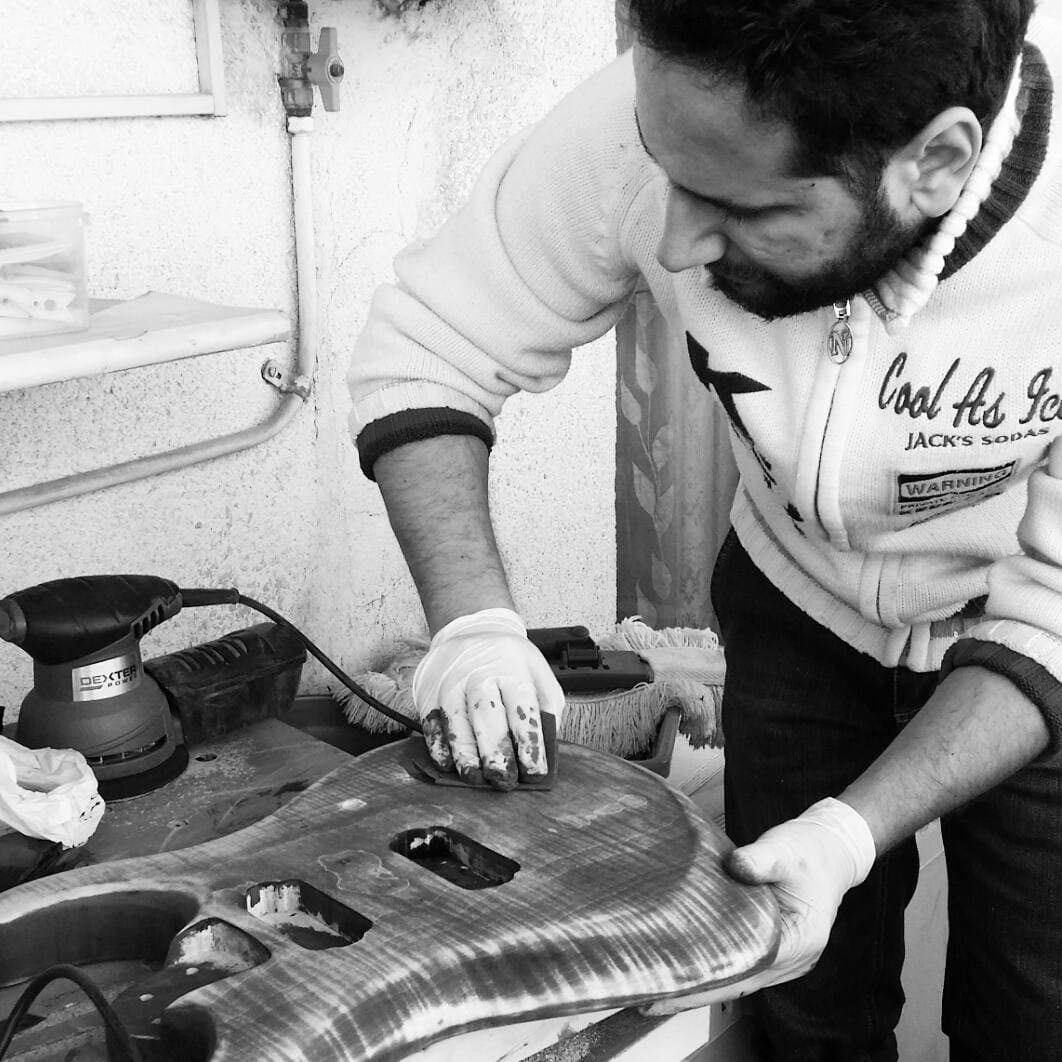
No departments, no handing over. The person who answers your first letter is the one who routs the body, wires the electronics and does the final check.
Time is part of the price
One instrument is worked on at a time, and it takes some months. That is not a delay: it is the condition that makes everything else possible.
Configurator
Let’s put it together.
Twenty choices in five chapters, to say what you have in mind. It is not an order and it commits you to nothing: it is where the conversation starts, and the luthier answers, not a form. To any of them you can answer not sure: it is what you would say on the other side of the bench, and it is perfectly fine.
Who is writing
The body
Shape, wood, colour: this is where it starts.
01
Guitar or bass?
It changes nearly everything that follows — the shapes, the woods, the number of frets — so it comes first. If you are just looking, start from the guitars: it is the wider range.
02
Which wood for the body?
It decides the weight and the character before anything else does. We look at the actual boards together later: here you only need to say which way to go.
03
Which finish?
These are real instruments, photographed one by one — and a few renderings, where the photograph does not exist yet. They are not colour charts: I mix the translucent tints by hand, one at a time, and you will get that name and that character, not that identical shade.
04
Which lacquer?
It is not only about looks: it changes how the wood breathes under your fingers and how it ages over the years.
The neck
The part your fingers touch on every note.
05
How many strings?
It changes the scale length, the neck width and the string spacing: this gets decided now, not later.
06
Which wood for the neck?
It decides stiffness and weight, and with them how far the instrument stays put when the climate changes. Maple is bright and lively, mahogany warmer and steadier, wenge hard and open-pored.
07
Which fretboard?
You touch it on every note: it is the part of the instrument your fingers deal with most.
08
Which frets?
It changes how far you sink in and how long the setup lasts. Anyone who bends a lot feels the difference straight away.
The markings
Fret markers and inlays: where an instrument becomes yours.
09
Side markers?
These are the ones you actually look at while playing. Luminlay charges up with light and stays visible in the dark: on a stage that changes everything.
10
Face markers?
The ones on the face of the fretboard. You see them more when the guitar is resting than when you are playing it, which is exactly why this is the place to allow yourself something.
11
Which inlay?
This is where one instrument stops resembling another. If you already have a design in mind, send it over: we start from there.
The sound
Pickups and switching, wired in the workshop.
12
De Gattis pickups or another brand?
The De Gattis pickups are wound in the workshop, one at a time: it is the part that decides the sound, and it is the part we make. If you arrive with something specific in mind — a model you have played and want to find again — we fit that instead.
13
Three-way or five-way switching?
Five ways gives you the in-between positions, three only the full combinations. The circuits are drawn and wired here, not bought in.
The hardware
Bridge, tuners, the finish on the metal.
14
Which bridge?
You pick the type; the make is what I fit as standard, and it is named below. For each type I fit whatever holds best at that price — Schaller, Gotoh, Hipshot, Vega-Trem — and that changes over time, because parts change. What you decide here is how the bridge works, which is the part you feel.
15
And the rest of the hardware?
Screws, jack, knobs, plates. It changes the character more than it looks like it should.
How it goes
Four steps, no surprises.
01
We talk
A conversation, not an automatic quote. What you play, what has never worked for you on the instruments you have owned, what you would want.
02
We choose the wood
Photographs of the boards on hand, with their figure and their flaws. The decision gets made on the real ones, not on a sample chart.
03
It gets built
Some months, one instrument at a time. You get pictures along the way: the routed body, the neck, the first coat of finish.
04
Final check and delivery
Final setup, certificate, case. And the option of coming back: an instrument made here gets repaired here.